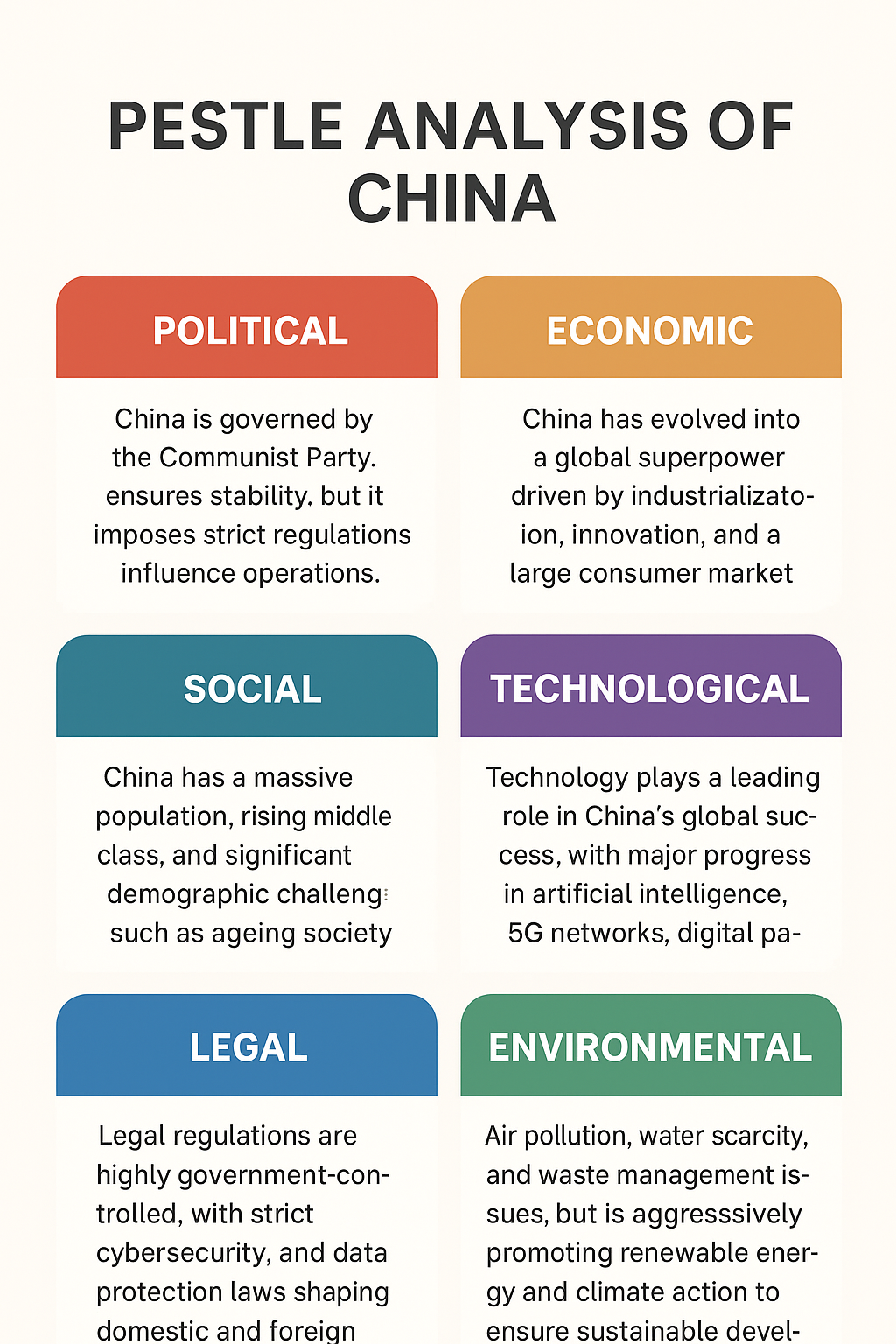
China stands as one of the world’s most influential economic powerhouses, blending rapid modernization with deeply rooted cultural traditions. Over the past few decades, it has transformed from a largely agrarian society into a global hub of manufacturing, technology, and innovation. This dramatic rise brings immense opportunities for businesses aiming to enter or expand within its vast market. A PESTEL analysis helps explore the major external factors that shape China’s business environment, including political control, fast-growing economic strength, shifting social trends, cutting-edge technology adoption, evolving legal frameworks, and environmental pressures. Understanding these elements provides a clearer lens for assessing market risks and strategic decisions in this dynamic and complex nation.
Political Factors of China
China, one of the world’s fastest-growing economies and a major global power, has a unique political framework that plays a crucial role in shaping its domestic and international environment. Governed by the Communist Party of China (CPC) since 1949, the country operates under a single-party socialist system that emphasizes centralized control, stability, economic progress, and national security. These political elements influence China’s business climate, global relations, regulatory environment, and social dynamics in significant ways.
One-Party Governance and Political Stability
A defining feature of China’s political system is its one-party rule. The CPC controls all major state institutions, policy-making processes, media platforms, and judicial systems. Due to this centralized structure, China enjoys strong political stability, which is crucial for long-term national development. Unlike multiparty democracies where frequent elections can introduce uncertainty, China’s leadership transitions are highly structured and predictable. This stability attracts foreign investment, as businesses prefer an environment where political risk is minimal.
However, the absence of political competition also raises concerns internationally regarding democratic freedoms, representation, and human rights. Despite these criticisms, the Chinese government continues to prioritize national unity and social harmony over political liberalization.
Strong Government Intervention in the Economy
The Chinese government plays an active role in directing and managing economic growth. Strategic industries such as technology, manufacturing, telecommunications, and energy are heavily supported and regulated by the state. The government’s Five-Year Plans guide national development, encouraging industrial innovation, infrastructure expansion, and poverty reduction.
State-Owned Enterprises (SOEs) continue to hold dominant positions in many sectors, which can limit competition for foreign companies. At the same time, China’s policies encourage foreign investment in high-tech and green energy industries, contributing to its rise as a global innovation leader.
Legal and Regulatory Environment
China’s legal system operates under the influence of the government, with laws often reflecting political goals rather than independent judicial reasoning. The government frequently updates policies related to foreign investment, trade, cybersecurity, environmental regulations, and intellectual property rights. While recent reforms have improved compliance, foreign firms can still experience challenges such as unclear regulations, licensing barriers, and unequal treatment compared to domestic companies.
Additionally, censorship laws and strict control over digital information significantly impact global businesses dealing with media, technology, and communication services in China.
Foreign Policy and Global Influence
China’s political strategy extends beyond its borders. Over the past decade, the nation has strengthened its global influence through initiatives like the Belt and Road Initiative (BRI)—a major international infrastructure and investment project connecting Asia, Europe, and Africa. This initiative enhances China’s economic reach but has faced criticism from some countries concerned about debt dependency and geopolitical influence.
China is also a permanent member of the United Nations Security Council, which gives it substantial power in global peacekeeping, policy decisions, and international diplomacy. However, tensions with countries such as the United States, India, and regions like the European Union affect trade policies, technology transfers, and global stability.
National Security and Social Control
National security is a top political priority in China. The government maintains extensive surveillance networks, internet censorship systems like the Great Firewall, and strict rules to prevent political dissent. These measures are justified by the state as necessary to prevent terrorism, separatism, and foreign influence.
In regions such as Xinjiang and Tibet, political control is even tighter, attracting global criticism relating to religious and cultural rights. Despite such controversies, China continues to enforce strict governance to maintain territorial integrity and internal safety.
Military Strength and Geopolitics
China has one of the world’s most powerful militaries and continues to modernize its defense systems to protect its sovereignty and assert its role in global security. Political tensions surrounding Taiwan and disputes in the South China Sea reflect China’s commitment to expanding its strategic influence. These geopolitical actions are key elements in understanding the political risks associated with operating or investing in the region.
Economic Factors of China
China stands as one of the most influential economies in the modern world, transitioning over the past few decades from a predominantly agrarian society into a global industrial powerhouse. The country’s economic progress has redefined international trade, investment flows, and global business strategies. Understanding the economic factors of China is essential for policymakers, foreign investors, and companies that engage with the world’s second-largest economy.
Rapid Economic Growth and Global Contribution
Since initiating economic reforms in 1978, China has maintained high levels of economic growth driven by industrialization, technology advancement, and export-oriented policies. Although recent years have seen moderate growth compared to past decades, China still contributes significantly to global GDP expansion. Its strong economic performance has helped lift millions of people out of poverty, making it a major economic engine of the Asia-Pacific region and the world.
Manufacturing Strength and Industrial Development
China is often regarded as “The World’s Factory” due to its large manufacturing base and cost-efficient production capabilities. The country excels in electronics, textiles, machinery, consumer goods, and chemical industries. Special economic zones (SEZs), favorable tax conditions, and government incentives have attracted multinational corporations to set up operations in China.
However, rising labor costs, global competition, and trade conflicts are encouraging China to shift from low-value manufacturing to high-tech and innovative industries such as artificial intelligence, electric vehicles, robotics, and renewable energy.
Export-Led Economy and International Trade
Exports continue to be a cornerstone of China’s economic strength. The country maintains strong trade relationships with nations across Asia, Europe, and the Americas. Through major seaports and logistics infrastructure, China dominates the supply chain of many industries.
Initiatives like the Belt and Road Initiative (BRI) further support its global trade ambitions by enhancing cross-border investment, transport routes, and market access. However, ongoing trade tensions—particularly with the United States—have introduced tariffs, restrictions, and uncertainties regarding the stability of global trade.
Large Domestic Market and Growing Middle Class
China’s massive population provides companies with access to the world’s largest consumer market. Major urban centers such as Shanghai, Beijing, Shenzhen, and Guangzhou sustain high demand for luxury products, digital services, entertainment, and modern lifestyles. The rise of the middle class has stimulated the retail sector, boosting e-commerce giants like Alibaba, JD.com, and Pinduoduo.
Despite growing incomes in urban areas, economic inequality between rural and metropolitan regions remains a significant challenge for balanced and inclusive development.
Government Economic Planning and Policy Influence
Economic planning in China is guided by national strategies, particularly the Five-Year Plans, which outline priorities such as technological innovation, environmental sustainability, and digital transformation. The government provides strong financial support to state-owned enterprises (SOEs), while also encouraging private sector growth in innovative fields.
Policies frequently change to align with national interests, which can create both opportunities and uncertainties for businesses. Foreign firms must comply with regulations concerning cybersecurity, data sovereignty, and intellectual property protection to operate smoothly.
Investment Landscape and Foreign Direct Investment (FDI)
China continues to attract significant foreign direct investment due to its infrastructure development, skilled workforce, and massive market scale. Sectors like finance, healthcare, renewable energy, and technology are increasingly open to international investors.
At the same time, stricter national security rules, licensing approvals, and protectionist measures can pose entry barriers. Many foreign businesses partner with local companies to navigate regulatory complexity and cultural norms.
Technological Innovation and Digital Economy
China is a global leader in technology adoption and digital transformation. The widespread use of mobile payments—via Alipay and WeChat Pay—has contributed to a cashless society. The government actively promotes research in:
-
Artificial intelligence (AI)
-
5G telecommunications
-
Semiconductor production
-
Green energy and battery technology
These advancements support China’s ambition to become a high-tech superpower and reduce reliance on foreign technology.
Infrastructure Strength and Urban Development
China has invested heavily in infrastructure such as high-speed railways, airports, smart cities, and modern highways. These projects not only improve domestic mobility but also support economic integration and distribution networks across the country. Infrastructure spending remains one of China’s primary methods for stimulating economic growth during global downturns.
Financial System and Currency Power
China’s financial system is evolving into a more global structure. The internationalization of the Chinese currency, the Yuan (RMB), is expanding as more countries use it for trade settlements and reserves. Meanwhile, Chinese stock markets in Shanghai, Shenzhen, and Hong Kong attract global investors.
However, risks such as high corporate debt, property market instability, and banking sector challenges can influence economic confidence and long-term sustainability.
Labor Market and Human Capital
China benefits from a large, increasingly educated workforce. Yet, demographic shifts—particularly an aging population and declining birth rates—pose future labor shortages. To counter these challenges, China is investing in higher education, vocational skills, and technological automation.
Social Factors of China
China is a country with deep-rooted cultural traditions, a diverse population, and rapidly evolving social dynamics. Over the years, major transformations in lifestyle, education, urbanization, and demographics have significantly influenced the way society functions. These social factors play a key role in shaping consumer behavior, business strategies, workforce trends, and national development priorities.
Population Size and Demographic Changes
China has the largest population in the world, which provides access to a massive labor force and consumer market. However, demographic trends are shifting due to aging, declining birth rates, and the long-term effects of the former One-Child Policy. The growing elderly population increases healthcare and social welfare needs, while the shrinking working-age population poses challenges for future economic productivity.
To address demographic imbalance, the government has introduced Two-Child and Three-Child Policies, but rising living costs and changing lifestyles have limited population growth recovery.
Urbanization and Rising Living Standards
Rapid urbanization has transformed China’s social structure. Millions of people have moved from rural villages to major cities seeking employment and better opportunities. This shift has expanded the middle class, leading to higher consumer spending on modern services such as education, travel, entertainment, and technology.
Urban residents enjoy better access to healthcare, transportation, and digital infrastructure, while rural areas still face development gaps. The government invests heavily in creating smart cities and improving living standards to support social stability.
Education System and Skilled Workforce
Education is highly valued in Chinese society. The country has achieved near-universal literacy and continues to strengthen its education system through curriculum reforms, global research collaboration, and innovation-focused institutions.
China produces millions of graduates annually in fields such as engineering, computer science, and business, creating a well-educated workforce that supports economic and technological advancements. However, intense academic pressure and fierce competition remain major concerns among students and families.
Cultural Values and Social Harmony
Traditional Chinese values are influenced by Confucian philosophy, emphasizing:
-
Respect for authority
-
Family loyalty
-
Social harmony
-
Collective well-being
These cultural values contribute to strong community relationships and a stable social environment. At the same time, modern lifestyles—driven by digital advancement—are changing attitudes toward family, marriage, and individual freedom, especially among younger generations.
Healthcare Development and Public Well-being
Healthcare access and quality have improved significantly over the past decades through government reforms, infrastructure expansion, and insurance programs. The country is increasingly investing in biotechnology, digital health, and pharmaceutical innovation.
However, challenges such as the aging population, rising chronic diseases, and unequal rural-urban healthcare access require ongoing policy attention.
Consumer Behavior and Market Trends
China’s consumers are becoming more brand-conscious, tech-savvy, and environmentally aware. Trends influencing market behavior include:
-
Heavy adoption of e-commerce and digital payments
-
High demand for luxury and international brands
-
Increased focus on health and fitness
-
Growth in leisure and tourism industries
These evolving preferences create profitable opportunities for both local and foreign companies targeting the Chinese market.
Diversity and Ethnic Composition
China is home to 56 officially recognized ethnic groups, with the Han Chinese being the majority. Cultural diversity enriches local traditions, cuisines, and festivals. However, tensions exist in some minority regions—such as Xinjiang and Tibet—relating to religious rights, cultural preservation, and political control.
These social sensitivities can impact international opinion, tourism, and business interests.
Technological Factors of China
China has rapidly emerged as a global leader in technological innovation, transforming itself from a manufacturing-driven economy into a powerhouse of digital advancement. Technology plays a central role in China’s economic reforms, social development, global competitiveness, and national security strategies. These technological factors shape business opportunities, digital lifestyles, and government policies throughout the country.
Government Support for Innovation
A defining strength of China’s technological growth is strong government intervention and policy support. Through national programs such as “Made in China 2025” and strategic Five-Year Plans, China heavily invests in innovation, research, and advanced manufacturing. State funding, tax incentives, and innovation hubs encourage local companies to pursue frontier technologies like artificial intelligence (AI), semiconductors, and robotics. These policies aim to decrease dependence on foreign technology and establish China as a tech-leading nation.
Advancements in Artificial Intelligence and Big Data
China is one of the world’s leaders in AI development, supported by vast data availability and growing expertise. AI applications in China are used in:
-
Smart cities and traffic management
-
Surveillance and facial recognition systems
-
Healthcare diagnostics
-
E-commerce personalization
-
Fintech and automated services
Big data plays a central role in both public governance and private sector innovation, strengthening China’s digital economy on a global scale.
Telecommunications and 5G Revolution
China has made major breakthroughs in telecommunications. Companies like Huawei and ZTE are pioneers in 5G technology, accelerating digital transformation in industries such as transportation, manufacturing, and healthcare. Lightning-fast connectivity supports the expansion of autonomous vehicles, Internet of Things (IoT) devices, and cloud technologies.
China’s leadership in 5G has also created geopolitical tensions, especially with Western countries concerned about data security and network control.
Booming E-Commerce and Digital Payments
China has one of the world’s most sophisticated digital marketplaces. Online shopping platforms—Alibaba, JD.com, Pinduoduo—dominate consumer lifestyles. Mobile payment systems like Alipay and WeChat Pay have made China a nearly cashless society.
Digital finance services such as online banking, micro-loans, and QR-code-based payments are deeply integrated into everyday life, setting new global standards for financial technology.
Smart Manufacturing and Automation
China is shifting from low-cost labor-based industries to advanced manufacturing. Robotics, industrial automation, and smart factories improve production quality and efficiency. Companies are investing in:
-
Industrial robots and automation systems
-
3D printing and smart supply chains
-
Electric and self-driving vehicles
This transformation supports China’s competitive edge and reduces reliance on manual labor amid demographic challenges.
Rise of the Tech Start-Up Ecosystem
Tech hubs like Shenzhen, Beijing, and Shanghai foster innovation with vibrant start-up environments. Venture capital investment and technology incubators support emerging companies in:
-
Biotechnology
-
Cloud computing
-
Gaming and entertainment tech
-
Energy solutions
These regions attract global entrepreneurs and skilled talent, expanding China’s role in the worldwide tech industry.
Cybersecurity and Regulations
The Chinese government enforces strict cybersecurity rules to protect national security and information control. Laws governing data storage, digital content, and online platforms affect how foreign companies operate. While this ensures digital sovereignty, it challenges businesses needing open access to global networks.
Platforms such as Google, Facebook, and YouTube remain restricted, allowing Chinese alternatives to dominate the domestic market.
Space Exploration and Scientific Research
China continues to advance in aerospace and scientific innovation. Achievements include:
-
Space missions and lunar exploration programs
-
BeiDou satellite navigation network
-
High-speed magnetic levitation (maglev) trains
-
Renewable energy advancements including solar technology and battery storage
These efforts enhance national pride and technological independence.
Environmental Factors of China
China’s environment plays a crucial role in shaping its development policies, industrial strategies, and global image. Rapid industrialization and economic growth have lifted millions out of poverty but also caused significant environmental challenges. Today, environmental protection has become a national priority as China aims to balance progress with sustainability. These environmental factors influence business operations, international relations, public health, and long-term economic planning.
Air Pollution and Clean Energy Transition
One of China’s most significant environmental issues is air pollution caused by heavy industries, coal-based energy production, and urban transportation. Major cities like Beijing and Shanghai have experienced hazardous smog episodes in the past. In response, China has become a global leader in renewable energy, especially:
-
Solar and wind power production
-
Electric vehicles and battery technology
-
Clean energy investments worldwide
The government is shutting down coal plants, enforcing emission controls, and supporting green technology to reduce pollution and improve air quality.
Climate Change Commitment and Green Policies
China is the world’s largest carbon emitter due to its massive industrial output. However, it has committed to strong environmental goals, including:
-
Carbon peak by 2030
-
Carbon neutrality by 2060
China actively participates in global climate agreements and invests in environmental science and technology. Policies like the National Carbon Trading Market help reduce emissions across large industries.
Water Scarcity and Pollution Control
Water scarcity is a major challenge, especially in northern regions. Industrial wastewater, agricultural chemicals, and untreated sewage have polluted rivers and lakes. To address this, China has:
-
Implemented the Water Pollution Prevention and Control Action Plan
-
Built advanced wastewater treatment facilities
-
Developed large water diversion projects like the South-to-North Water Transfer
These measures aim to secure clean water supplies for citizens and maintain ecological sustainability.
Waste Management and Recycling Systems
With a huge population and increasing consumption, China deals with massive waste production. Plastic pollution and electronic waste are key concerns. In recent years, China:
-
Banned foreign waste imports to protect environmental safety
-
Introduced strict recycling regulations in major cities
-
Developed modern waste-to-energy facilities
These actions encourage responsible waste handling and promote a circular economy model.
Biodiversity Protection and Wildlife Management
China has diverse ecosystems, from rainforests and deserts to coastal zones and mountains. Environmental degradation threatens wildlife habitats and endangered species such as the panda and Yangtze river dolphin. Conservation efforts include:
-
Establishing national parks and protected areas
-
Forest restoration projects and tree planting campaigns
-
Habitat recovery and species protection programs
China now holds a leading role in global biodiversity conservation discussions.
Agriculture, Soil Degradation, and Food Security
Agriculture remains vital to China’s economy, but overuse of fertilizers, soil contamination, and land erosion have affected farmland productivity. To protect food security, China focuses on:
-
Sustainable farming methods
-
Soil monitoring and rehabilitation programs
-
Reducing pesticide and chemical usage
Government policies aim to preserve agricultural land while improving crop quality and safety.
Urbanization and Environmental Stress
Rapid urban growth has increased pressure on natural resources, transportation infrastructure, and waste management systems. As cities expand:
-
Green architecture and eco-friendly construction are encouraged
-
Public transportation and electric vehicles reduce emissions
-
Urban green areas improve livability and air quality
China’s sustainable city initiatives serve as models for environmental urban planning.


Leave a Reply