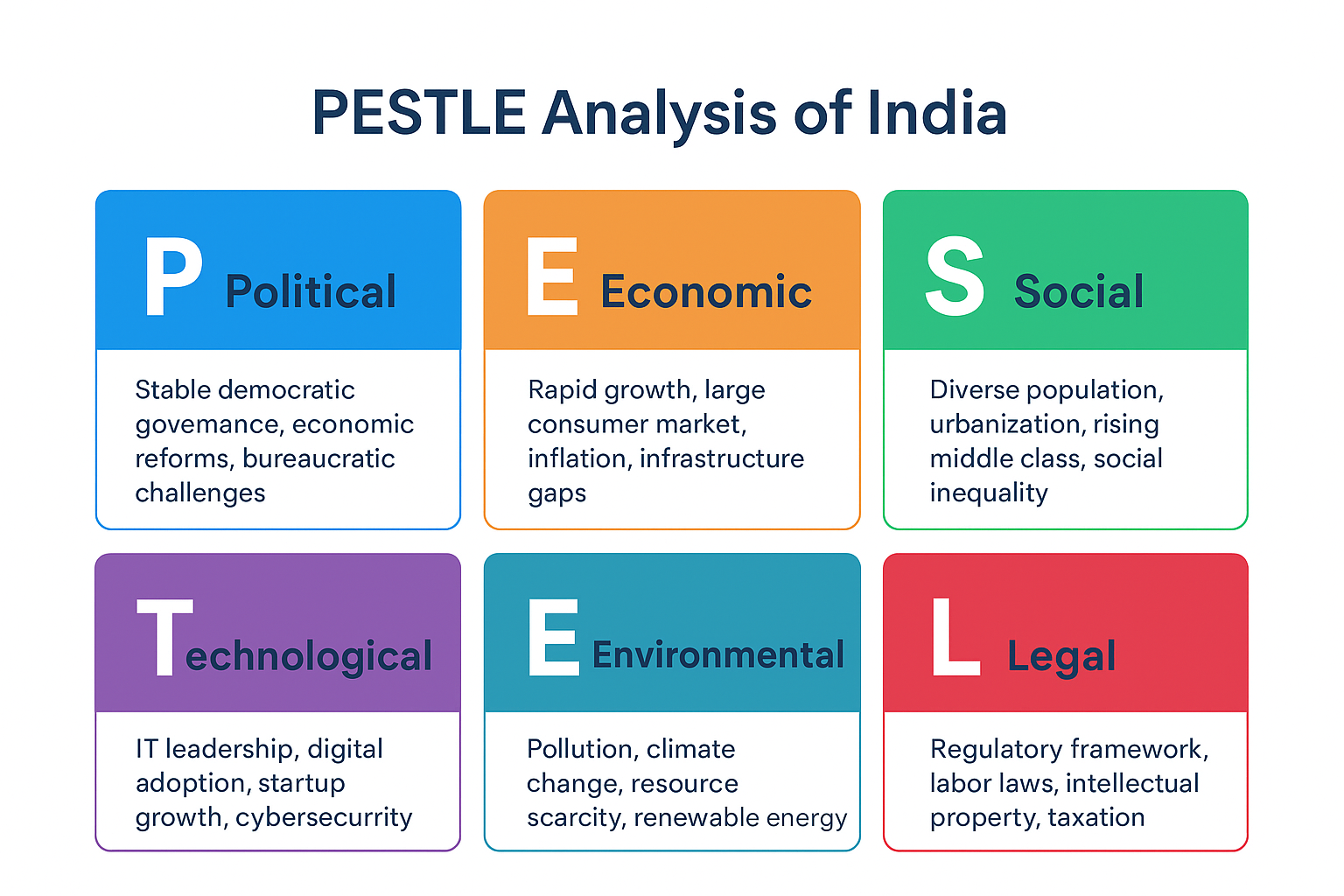
A PESTLE analysis of India provides a comprehensive overview of the external macro-environmental factors that influence the country’s economic growth, business environment, and overall development. As one of the world’s fastest-growing economies and the largest democracy, India operates within a complex landscape shaped by political structures, economic reforms, social diversity, technological advancements, environmental challenges, and legal frameworks. Understanding these elements helps businesses, investors, and policymakers make informed decisions and identify both opportunities and potential risks within the Indian market.
Political Factors of India
India’s political environment plays a crucial role in shaping its economic direction, business climate, and global influence. As the world’s largest democracy with a multiparty parliamentary system, India’s political structure is characterised by stability, a strong constitutional framework, and active participation from its diverse population. These political dynamics strongly impact trade policies, foreign investment, infrastructure development, and regulatory frameworks. Understanding India’s political environment is essential for businesses and investors aiming to operate or expand within the country.
1. Democratic Governance and Political Stability
India operates under a democratic parliamentary system, where power is divided between the central government and individual states. Elections are held regularly at local, state, and national levels, ensuring widespread political participation. Although political debates and competition among parties can create policy delays, India has maintained overall political stability for decades. This stability helps build investor confidence and supports long-term business planning.
2. Federal Structure and State-Level Influence
India’s federal system gives individual states significant autonomy over areas like land regulation, law and order, and local taxation. This means business environments can vary between states—some offer more investor-friendly policies, while others are slower in implementing reforms. States such as Maharashtra, Karnataka, and Gujarat often emerge as business hubs due to proactive governance and efficient administrative frameworks.
3. Government Policies and Economic Reforms
The Indian government has introduced several economic reforms aimed at promoting investment, easing business operations, and modernizing various sectors. Key reforms include:
-
Goods and Services Tax (GST), which simplified the indirect tax system
-
Make in India, encouraging manufacturing and job creation
-
Digital India, promoting digitization and digital infrastructure
-
Foreign Direct Investment (FDI) relaxations in sectors like retail, aviation, and defense
These policy initiatives support economic growth and provide new opportunities for global investors.
4. Foreign Relations and Trade Policies
India maintains diplomatic relations with major global economies, including the United States, European Union, Japan, and Southeast Asian countries. Strengthening international ties has led to expanded trade partnerships, technology collaborations, and defense agreements. However, geopolitical tensions with neighboring countries like China and Pakistan can occasionally affect investor sentiment and regional stability.
5. Bureaucracy and Regulatory Environment
While significant reforms have been made, India is still known for bureaucratic complexities, lengthy approval processes, and regulatory delays in some sectors. Issues such as corruption, administrative inefficiencies, and inconsistent enforcement of policies can create challenges for businesses. However, government initiatives like digital governance, online approvals, and anti-corruption measures aim to reduce these hurdles.
Economic Factors of India
India is one of the world’s fastest-growing major economies, driven by its expanding consumer market, strong service sector, and ongoing economic reforms. With a population exceeding 1.4 billion and a rapidly rising middle class, India presents enormous opportunities for global businesses and investors. However, the country’s economic landscape also includes structural challenges such as unemployment, inflation, and infrastructure gaps. Understanding these economic factors is essential for assessing India’s growth potential and market attractiveness.
1. Rapid Economic Growth and Market Potential
India consistently ranks among the fastest-growing large economies, driven by domestic consumption, digital expansion, and increasing industrial output. A youthful population with rising disposable incomes is fueling demand across sectors such as retail, technology, real estate, and finance. This makes India a highly attractive market for both domestic and foreign investors.
2. Large and Expanding Consumer Base
With one of the largest populations in the world, India offers a massive consumer market. The middle class is expanding quickly, contributing to increased spending on healthcare, education, technology, travel, and lifestyle products. Urbanization is also driving growth in real estate, transportation, and infrastructure projects.
3. Sectoral Composition of the Economy
India’s economy is broadly divided into three key sectors:
a. Services Sector (Largest Contributor)
The services sector contributes more than half of India’s GDP. Key industries include:
-
Information Technology (IT)
-
Business Process Outsourcing (BPO)
-
Finance and banking
-
Telecommunications
-
Tourism and hospitality
India is a global leader in IT and software services, exporting billions worth of technology solutions worldwide.
b. Industrial Sector
The industrial segment includes manufacturing, construction, and mining. Initiatives like Make in India aim to strengthen this sector by encouraging domestic and foreign companies to set up manufacturing units.
c. Agricultural Sector
Agriculture remains a significant employer, though its share of GDP is declining. Challenges include dependency on monsoon rains and low productivity, but modernization efforts are underway.
4. Foreign Direct Investment (FDI) and Global Trade
The Indian government has liberalized FDI policies in multiple sectors, attracting multinational companies to invest in retail, automotive, telecommunications, and defense. India’s trade relations with major economies such as the U.S., EU, Japan, and ASEAN countries contribute positively to economic growth.
However, trade imbalances, especially with China, continue to be a concern.
5. Infrastructure Development
Infrastructure development is a top priority for the Indian government. Massive investments are being made in sectors such as:
-
Highways and expressways
-
Smart cities
-
Railways modernization
-
Renewable energy projects
-
Digital infrastructure
Despite progress, gaps remain in logistics, quality transport, and energy supply, which can increase operational costs for businesses.
Social Factors of India
India’s social environment is shaped by its vast population, deep cultural heritage, linguistic diversity, and evolving lifestyle patterns. As one of the most culturally rich and demographically dynamic countries in the world, India presents unique opportunities and challenges for businesses, policymakers, and investors. Understanding the social factors of India is essential for assessing consumer behavior, workforce characteristics, and long-term market potential.
1. Large and Diverse Population
India is home to over 1.4 billion people, making it the world’s most populous nation. This large population fuels a massive labour force and consumer market. However, managing social welfare, healthcare, and employment for such a large population also poses significant challenges.
2. Cultural Diversity and Traditions
India’s culture is influenced by its multilingual, multiethnic, and multireligious society. The country celebrates numerous festivals and traditions that vary by region. This cultural richness greatly influences consumer preferences, entertainment, fashion, and food industries. Businesses entering the Indian market must consider cultural sensitivities and regional variations in tastes and behaviour.
3. Growing Middle Class and Lifestyle Changes
India’s middle class is increasing rapidly, leading to higher disposable incomes and rising demand for quality education, healthcare, housing, and luxury goods. Urban lifestyles are shifting towards modern consumer habits, including online shopping, travel, and higher spending on lifestyle products and services. This creates strong growth opportunities across retail, real estate, tourism, and entertainment sectors.
4. Urbanization Trends
India is witnessing rapid urbanization, with millions migrating from rural to urban areas in search of better employment and education. Urban centres like Mumbai, Delhi, Bangalore, and Hyderabad are growing rapidly, contributing to increased demand for housing, transportation, and public services. However, urbanization also brings challenges such as overcrowding, pollution, and pressure on infrastructure.
5. Education and Literacy Levels
India has made significant progress in improving literacy rates, especially among youth. The government’s focus on education, digital learning, and skill development programs has helped build a more educated workforce. However, disparities still exist between urban and rural areas, and the quality of education varies widely. Skill gaps in technical fields remain a challenge for industries.
6. Workforce Characteristics
India has one of the youngest populations in the world, with a median age of around 28 years. This “demographic dividend” creates a strong labour supply for industries such as IT, manufacturing, and services. However, unemployment, underemployment, and informality in labour markets persist, affecting overall productivity.
7. Health and Healthcare System
India’s healthcare system is improving through government initiatives, private hospitals, and digital health platforms. Despite progress, challenges like uneven access to healthcare, malnutrition, and lifestyle diseases remain. The quality of healthcare varies significantly between states and between urban and rural regions.
Technological Factors of India
India has emerged as one of the world’s leading technology hubs, driven by rapid digital transformation, innovation, and strong government support for tech-driven growth. With a booming IT industry, expanding startup ecosystem, and large pool of skilled engineers, India’s technological environment significantly contributes to its economic development and global competitiveness. Understanding these technological factors is essential for businesses looking to leverage India’s digital potential.
1. Strong IT and Software Industry
India is globally recognized for its information technology (IT) and software services sector. Cities like Bangalore, Hyderabad, Pune, and Chennai host thousands of IT firms, including multinational corporations and homegrown giants. India’s expertise in software development, cloud computing, AI, data analytics, and cybersecurity has made it a major technology exporter.
2. Growing Startup Ecosystem
India is one of the world’s largest startup ecosystems, with thousands of new companies emerging annually. Sectors such as fintech, edtech, healthtech, e-commerce, and artificial intelligence have seen rapid growth. Government initiatives like Startup India and Digital India provide financial support, tax benefits, and incubation facilities, making India a hotspot for innovation and entrepreneurship.
3. Digital Transformation and Internet Penetration
India has seen massive digital adoption in recent years. Affordable smartphones and low-cost data plans have increased internet penetration, especially in rural areas. Popular digital services include:
-
Online banking and digital payments (UPI)
-
E-commerce platforms
-
E-learning portals
-
Telemedicine and online health services
The rapid shift toward digital platforms is transforming consumer behavior and business operations.
4. Advancements in Telecommunications
India has one of the largest telecom markets in the world. The rollout of 4G across the country and ongoing expansion of 5G networks are boosting connectivity and enabling advancements in smart cities, Internet of Things (IoT), and automation. Telecom reforms are helping to improve service quality and expand network reach.
5. Government Support for Technology Growth
The Indian government promotes technological advancements through various initiatives:
-
Digital India to enhance digital infrastructure and online services
-
Make in India to boost domestic electronics manufacturing
-
National AI Strategy to encourage artificial intelligence adoption
-
Smart Cities Mission to promote tech-based urban development
These initiatives create a favourable environment for tech investments and innovation.
Legal Factors of India
India’s legal environment plays a crucial role in shaping the country’s business landscape, regulatory climate, and investment attractiveness. As a democratic nation with a well-established judicial system, India has a comprehensive framework of laws governing corporate operations, labour, intellectual property, taxation, environment, and foreign investment. However, challenges like slow judicial processes and regulatory complexity still influence the ease of doing business. Understanding India’s legal factors is essential for any organization planning to operate or expand within the country.
1. Comprehensive Legal and Judicial Framework
India follows a common-law system inherited from British rule, featuring a structured hierarchy of courts—from district courts to High Courts and the Supreme Court. The Constitution serves as the supreme legal authority, offering strong protections for fundamental rights, business operations, and property ownership.
However, judicial delays and case backlogs often slow dispute resolution, sometimes discouraging investors.
2. Business Laws and Corporate Regulations
Businesses operating in India must comply with key laws such as:
-
Companies Act, 2013 – governs corporate structure, governance, and compliance
-
Competition Act, 2002 – prevents monopolies and promotes fair trade
-
Insolvency and Bankruptcy Code (IBC), 2016 – streamlines business insolvency and restructuring
-
Foreign Exchange Management Act (FEMA), 1999 – regulates foreign investment and currency transactions
These laws provide clarity and protection for business entities, although compliance requirements can be extensive.
3. Labour Laws and Employment Regulations
India has numerous labour laws dealing with wages, safety, working conditions, and employee rights. Key labour regulations include:
-
Minimum Wages Act
-
Factories Act
-
Industrial Disputes Act
-
Employees’ Provident Fund (EPF)
-
New Labour Codes (2020)—consolidating multiple labour laws to simplify regulations
While the new labour codes aim to promote flexibility and ease compliance, their full implementation varies across states.
4. Intellectual Property Rights (IPR) Protection
India has strengthened its intellectual property framework to support innovation and attract foreign investment. The legal system protects:
-
Patents
-
Trademarks
-
Copyright
-
Designs
-
Geographical Indications (GI)
Though enforcement has improved, challenges remain with piracy, slow processing times, and limited awareness in rural areas.
5. Taxation System and GST
India’s taxation environment underwent a major transformation with the introduction of the Goods and Services Tax (GST) in 2017. GST simplified indirect taxes by merging multiple state and central taxes into one unified system. Other major tax laws include:
-
Income Tax Act
-
Customs and excise regulations
-
Transfer pricing laws
Despite improvements, businesses must still navigate complex compliance requirements and frequent rule changes.
6. Foreign Direct Investment (FDI) Regulations
India allows foreign investment across many sectors, with rules governed by FEMA and FDI policies updated regularly. Some sectors, like defense and telecom, have caps or require government approval. Liberalized norms have encouraged multinational companies to enter the Indian market.
Environmental Factors of India
India’s environmental landscape is shaped by its vast geography, diverse climate, rising population, industrial growth, and growing environmental awareness. While the country possesses rich natural resources, fertile land, and a strong agricultural base, it also faces major challenges related to pollution, deforestation, climate change, and waste management. Environmental factors play a significant role in shaping government policies, business operations, infrastructure development, and public health. Understanding these factors is essential for organizations planning sustainable operations within India.
1. Geographic Diversity and Natural Resources
India’s environment includes mountains, plains, deserts, coastal regions, and dense forests. This geographic diversity supports:
-
Agriculture
-
Tourism
-
Mining
-
Hydropower
-
Fisheries
The country is rich in resources like coal, iron ore, bauxite, and fertile soils. However, unsustainable extraction practices can threaten long-term ecological balance.
2. Climate Change Vulnerability
India is highly vulnerable to climate change due to its geographic location and population density. The country regularly faces:
-
Heatwaves
-
Floods
-
Droughts
-
Cyclones
-
Irregular monsoons
These climate-related events impact agriculture, infrastructure, and public safety. The government is increasingly investing in climate adaptation and disaster management strategies.
3. Air Pollution Challenges
Air pollution is one of the most serious environmental challenges in India. Major cities such as Delhi, Mumbai, and Kolkata often experience poor air quality due to:
-
Vehicular emissions
-
Industrial activities
-
Construction dust
-
Crop burning
-
Coal-based power plants
Air pollution affects public health, productivity, and healthcare costs, making it a major environmental concern.
4. Water Scarcity and Water Pollution
Despite having major rivers, India faces severe water challenges. Key issues include:
-
Groundwater depletion
-
Contaminated drinking water
-
Industrial and domestic wastewater discharge
-
Water scarcity in urban and rural areas
Programs like the Namami Gange Mission and Jal Jeevan Mission aim to improve water quality and ensure clean water access.
5. Waste Management Issues
India generates millions of tons of solid waste annually, and waste management remains a significant challenge. Problems include:
-
Poor segregation of waste
-
Overloaded landfills
-
Electronic waste accumulation
-
Plastic pollution
The government promotes recycling, banning single-use plastics, and implementing waste-to-energy projects.
6. Deforestation and Biodiversity Loss
Urban expansion, logging, mining, and agriculture contribute to deforestation. India’s rich biodiversity, including endangered wildlife species, is threatened by:
-
Habitat destruction
-
Human-wildlife conflict
-
Illegal poaching
-
Climate change
Conservation programs and wildlife protection laws aim to preserve forests and ecosystems, but enforcement varies across regions.
7. Renewable Energy Expansion
India is making strong progress in transitioning to renewable energy. Key initiatives include:
-
Solar power expansion
-
Wind energy projects
-
Hydropower development
-
Green hydrogen mission
India is one of the world’s leading countries in solar energy capacity, driven by government incentives and private investments.
Conclusion
India stands out as one of the world’s most dynamic and promising markets, shaped by a unique blend of political stability, economic growth, social diversity, technological innovation, environmental challenges, and an evolving legal framework. As the largest democracy with a fast-growing economy, India offers immense opportunities for global investors, businesses, and policymakers.
Politically, stable democratic governance and ongoing reforms support long-term growth, though bureaucratic complexities remain a challenge. Economically, India benefits from rapid expansion, a growing middle class, and strong service and technology sectors, despite issues such as unemployment, inflation, and infrastructure gaps. The social landscape is marked by demographic advantages, urbanization, and cultural diversity, creating a large consumer base but also highlighting inequalities and healthcare disparities.
Technologically, India is emerging as a global innovation hub, driven by IT leadership, digital adoption, and startup growth, even as digital divides and cybersecurity concerns persist. Environmentally, the country faces significant pressures—pollution, climate change, and resource scarcity—but is also progressing rapidly in renewable energy and sustainability initiatives. Legally, India’s comprehensive regulatory system provides strong protections for businesses and consumers, though slow judicial processes and compliance complexities can affect operational efficiency.


Leave a Reply