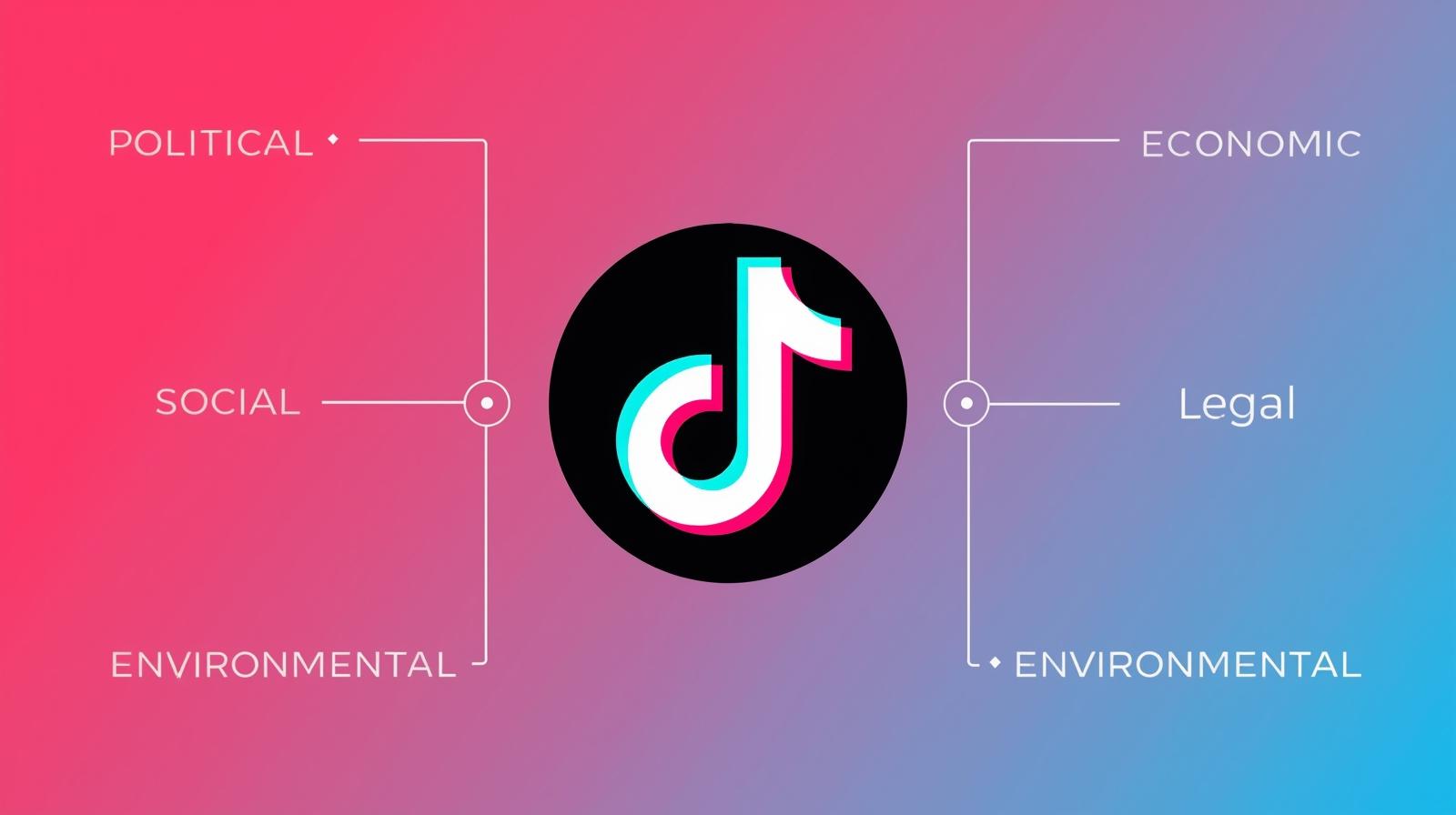
TikTok, developed by the Chinese company ByteDance, has become one of the most influential social media platforms in the world. Since its global launch in 2017, TikTok has revolutionized the way people create and consume short-form video content. With over a billion active users, it serves as a powerful platform for entertainment, marketing, and cultural trends. However, its rapid rise has also attracted global attention from governments, regulators, and competitors. A PESTLE analysis (Political, Economic, Social, Technological, Legal, and Environmental) helps to understand the external factors affecting TikTok’s operations and strategic decisions. This analysis explores how political regulations, economic conditions, social behaviors, technological innovations, legal challenges, and environmental concerns influence TikTok’s global growth and sustainability.
Political Factors of TikTok
The political landscape has a significant influence on TikTok’s operations, expansion, and global reputation. As a product of the Chinese technology company ByteDance, TikTok operates in an environment shaped by international diplomacy, government regulations, and public policies. Political concerns over data security, privacy, and foreign influence have made TikTok one of the most politically scrutinized social media platforms in the world.
1. Geopolitical Tensions and Government Scrutiny
One of the most defining political challenges for TikTok stems from geopolitical tensions between China and Western nations. Since TikTok’s parent company, ByteDance, is headquartered in Beijing, many governments—particularly the United States and European Union members—have raised concerns about user data potentially being accessed by the Chinese government under China’s National Intelligence Law.
In the United States, TikTok has faced continuous investigations and threats of bans due to allegations that it could pose a national security risk. Lawmakers have introduced several bills aimed at restricting or banning the platform, citing potential data misuse and propaganda risks. This has forced TikTok to implement transparency measures, such as establishing Project Texas in the U.S., which ensures that American user data is stored and managed locally by Oracle.
Similarly, India banned TikTok outright in 2020 along with several other Chinese apps, citing national security concerns amid border tensions between India and China. This ban eliminated one of TikTok’s largest user bases, demonstrating how political issues can directly impact the company’s market presence and revenue.
2. International Trade Relations and Policy Barriers
TikTok’s operations are also influenced by global trade relations and international policies. The ongoing U.S.–China trade conflict has created an uncertain business environment for Chinese technology firms operating internationally. Trade restrictions, sanctions, and diplomatic disputes often affect the perception and operations of companies like ByteDance.
Governments worldwide have become increasingly cautious about allowing foreign tech firms to dominate their digital ecosystems. As a result, many countries are enforcing digital sovereignty policies, requiring technology platforms to store user data within national borders. These measures increase TikTok’s operational costs and demand significant investment in regional data centers in Europe, Asia, and North America to comply with local regulations.
3. Political Pressure on Content Regulation
Governments across different regions have distinct rules regarding online content, and TikTok must adapt its moderation policies to align with these national standards. Countries such as Indonesia, Pakistan, and Bangladesh have temporarily banned or warned TikTok for hosting content deemed inappropriate, offensive, or politically sensitive.
TikTok must balance freedom of expression and local compliance to maintain access to these markets. Failure to comply with political and cultural standards can lead to restrictions, reputational damage, or complete bans. As a result, the company has strengthened its content moderation systems and invested heavily in teams responsible for reviewing and removing content that violates local regulations.
4. Data Privacy Laws and Political Regulations
The introduction of strict data protection regulations, such as the General Data Protection Regulation (GDPR) in Europe, has added another layer of political and legal pressure on TikTok. Governments demand that tech companies maintain transparency in how they collect, process, and store user information.
To address these concerns, TikTok has announced Project Clover in the European Union, similar to Project Texas in the U.S., aimed at building user trust and ensuring compliance with European data privacy standards. These political regulations significantly shape TikTok’s internal data management structure, forcing the platform to adopt more transparent and secure systems.
5. Digital Nationalism and Protectionist Policies
In recent years, a rise in digital nationalism has led many governments to promote domestic alternatives to foreign apps. This protectionist mindset limits TikTok’s ability to compete freely in certain markets. For example, after India banned TikTok, local platforms like Chingari and Moj quickly gained popularity, benefiting from government-backed narratives encouraging local innovation and digital independence.
These policies reflect a broader political trend in which nations seek to protect their digital borders, ensuring that domestic companies control user data and influence. Consequently, TikTok faces political resistance not only from foreign governments but also from emerging competitors supported by nationalistic agendas.
Economic Factors of TikTok
TikTok’s economic environment plays a crucial role in determining its growth, profitability, and long-term sustainability. As a leading global social media platform owned by ByteDance, TikTok has transformed from a simple short-video app into a multi-billion-dollar business ecosystem that influences global marketing, advertising, and digital commerce. However, like any international company, TikTok’s operations are shaped by various economic factors such as global market conditions, consumer spending patterns, competition, monetization strategies, and macroeconomic fluctuations.
1. Global Market Expansion and Economic Growth
TikTok’s rapid success is closely tied to global economic growth and digitalization trends. As internet access and smartphone usage have increased, especially in emerging economies, TikTok has expanded into hundreds of markets, gaining over 1 billion active users worldwide. The platform benefits from the growth of the digital economy, where consumers increasingly spend time and money online for entertainment and shopping.
Economic development in countries such as India (before its ban), Indonesia, Brazil, and the United States has enabled TikTok to attract a diverse audience. These expanding markets create opportunities for TikTok to increase advertising revenue, introduce in-app purchases, and collaborate with global brands.
However, the company’s dependence on global economic conditions means that recessions or slowdowns—such as those caused by inflation or post-pandemic recovery—can reduce advertising budgets and lower consumer spending, directly impacting TikTok’s profitability.
2. Advertising Revenue and Monetization Strategies
TikTok’s primary source of income is advertising revenue, similar to other social media giants like Meta (Facebook, Instagram) and YouTube. Businesses of all sizes use TikTok’s platform to promote their products through paid ads, influencer collaborations, and viral marketing campaigns. With its advanced algorithm and large user base, TikTok offers highly targeted advertising opportunities that attract global brands.
In 2024, TikTok’s advertising revenue surpassed $10 billion, making it one of the fastest-growing platforms in digital marketing. The platform’s short-video format and ability to make content go viral provide companies with strong returns on investment. Additionally, TikTok has introduced TikTok for Business, which enables advertisers to create, manage, and track campaigns efficiently.
Beyond advertising, TikTok has diversified its revenue streams through e-commerce integration and live streaming features. In countries like China, the U.K., and the U.S., TikTok has launched TikTok Shop, allowing users to buy products directly through the app. This has created a new digital retail channel, connecting influencers, sellers, and buyers within one ecosystem.
3. Impact of Economic Recessions and Inflation
Global economic downturns and inflation can have a significant effect on TikTok’s revenue growth. When the economy slows down, businesses tend to cut advertising budgets, reducing TikTok’s main source of income. Similarly, inflation affects both operational costs and consumer spending habits.
For instance, during periods of high inflation, people may spend less on luxury products or online shopping, leading to reduced engagement with TikTok’s commercial content. At the same time, the cost of running data centers, marketing campaigns, and global operations increases.
Despite these challenges, TikTok’s entertainment-based model often provides a degree of resilience during economic downturns, as users tend to seek low-cost digital entertainment. This helps TikTok maintain strong user engagement even during global recessions.
4. Competitive Economic Environment
TikTok operates in a highly competitive economic landscape, facing major rivals like YouTube Shorts, Instagram Reels, and Snapchat Spotlight. These competitors constantly innovate to attract users and advertisers, creating a price and performance competition within the digital ad industry.
To stay competitive, TikTok invests heavily in AI-driven algorithms, creator incentives, and global marketing. ByteDance spends billions annually to enhance user experience and support content creators through programs that offer financial rewards for popular videos. However, these investments increase operational costs, requiring consistent revenue growth to remain profitable.
Moreover, TikTok must navigate the economic dominance of Western tech companies, which control much of the global ad market. This competition limits TikTok’s market share in certain regions, forcing the company to find alternative sources of income such as partnerships, e-commerce, and subscription-based features.
5. Creator Economy and Employment Opportunities
TikTok has become a cornerstone of the global creator economy, generating income opportunities for millions of users. Influencers, musicians, and small business owners earn revenue through brand partnerships, affiliate marketing, and TikTok’s Creator Fund and Creator Rewards Program.
This creator-driven ecosystem contributes to local and global economies by promoting digital entrepreneurship. Small businesses, especially during the COVID-19 pandemic, relied on TikTok to reach new audiences and boost sales through viral content.
However, TikTok faces criticism that its creator compensation is inconsistent, and competition from platforms like YouTube (which offers better monetization) could affect its ability to retain top talent. Still, by empowering content creators and small businesses, TikTok plays an essential role in the evolving digital economy.
6. Foreign Investment and Business Partnerships
As a global company, TikTok relies heavily on foreign investment, business partnerships, and brand collaborations. Its economic success depends on stable relationships with advertisers, entertainment companies, and governments that regulate foreign investment.
In some countries, political and economic barriers—such as trade restrictions, digital taxes, or sanctions—can limit TikTok’s ability to attract investment or generate profit. For example, local data storage and tax regulations may increase operational costs. To overcome these challenges, TikTok forms regional partnerships with companies like Oracle (in the U.S.) and global entertainment brands to strengthen its financial and technological infrastructure.
Social Factors of TikTok
Social factors play a central role in TikTok’s growth, popularity, and influence around the world. As a platform driven by user-generated content, TikTok reflects and shapes modern social behavior, communication trends, and cultural identities. Its success lies in understanding human interaction, creativity, and the desire for connection and entertainment. The app has redefined how people consume content, express themselves, and engage with communities across diverse cultures and age groups.
2. Youth Culture and Generational Influence
TikTok’s user base is dominated by Generation Z and Millennials, making it a major influence on global youth culture. Young users use TikTok not only for entertainment but also as a tool for education, activism, and self-expression. Through creative videos, dance challenges, comedy skits, and personal storytelling, TikTok has become a platform where young people shape social trends and voice their opinions on important issues.
The app encourages creativity, inclusivity, and individuality. Many users find it easier to share their thoughts or talents in short videos than through long posts or photos. As a result, TikTok has become a cultural movement, empowering users to connect, learn, and express themselves in a supportive digital community.
3. Viral Trends and Pop Culture Influence
TikTok’s ability to create viral trends is one of its most powerful social factors. Challenges, dances, memes, and sounds often start on TikTok before spreading to other platforms and mainstream culture. Music, fashion, and even language trends are heavily influenced by TikTok’s content ecosystem.
For instance, songs that trend on TikTok frequently climb global music charts due to the platform’s massive reach. Fashion brands and beauty influencers use viral challenges to launch new styles, while celebrities collaborate with creators to stay relevant among younger audiences. TikTok has essentially become a cultural engine, driving entertainment, lifestyle, and consumer behavior across the world.
4. Community Building and Social Connection
Another significant social factor of TikTok is its emphasis on community and social belonging. Through shared interests and hashtags, users form communities around hobbies, professions, and lifestyles—such as #BookTok (books), #FoodTok (cooking), #EduTok (education), and #FitTok (fitness). These communities foster engagement and allow users from different backgrounds to connect over common passions.
The app’s algorithm also plays a vital role in promoting community growth by recommending content based on user preferences, not just followers. This democratizes content creation, giving everyone a chance to gain visibility regardless of social status or location. Such inclusivity strengthens TikTok’s reputation as a platform where creativity and connection are accessible to all.
5. Social Awareness and Activism
TikTok has evolved beyond entertainment into a platform for social awareness and activism. Users worldwide use it to raise their voices about issues like climate change, gender equality, racial justice, and mental health. Movements such as #BlackLivesMatter, #MeToo, and #SaveThePlanet have gained momentum through TikTok’s short, impactful videos that spread awareness rapidly.
This reflects a broader social shift where young generations use social media for civic engagement and education. TikTok has also partnered with organizations and influencers to promote campaigns about mental health, education, and diversity, demonstrating its role as a socially conscious platform.
However, TikTok must also manage the risks associated with misinformation and online extremism. Balancing free expression with responsible content moderation remains a major social challenge for the company.
Technological Factors of TikTok
Technology lies at the heart of TikTok’s global success. As one of the most advanced and innovative social media platforms, TikTok has leveraged cutting-edge technologies to revolutionize how people create, share, and consume content. Its rapid growth and global dominance are driven by strong technological infrastructure, artificial intelligence (AI), machine learning (ML), and continuous innovation in digital entertainment. The following sections explore the key technological factors that influence TikTok’s operations, competitiveness, and user engagement.
1. Advanced Algorithm and Artificial Intelligence (AI)
One of TikTok’s biggest technological strengths is its highly sophisticated AI-driven recommendation algorithm. This system analyzes user interactions—such as likes, shares, comments, and viewing time—to personalize each user’s “For You Page” (FYP). Unlike other platforms that rely heavily on follower-based feeds, TikTok’s algorithm prioritizes content discovery, ensuring that even new creators can go viral.
This advanced AI enables TikTok to understand user preferences with remarkable accuracy, providing a unique and addictive user experience. It’s the primary reason behind TikTok’s high engagement rates and global popularity. However, this same technology raises concerns about data privacy, digital addiction, and content manipulation, which require responsible AI management.
2. Machine Learning and Data Analytics
TikTok employs powerful machine learning (ML) systems to continuously analyze vast amounts of user data. These technologies help the platform improve content recommendations, advertising targeting, and user safety measures. ML algorithms detect trending topics, identify harmful content, and optimize ad performance based on user behavior.
Through predictive analytics, TikTok can anticipate user interests and serve highly relevant content in real-time. This data-driven personalization gives the platform a competitive edge over rivals like Instagram Reels and YouTube Shorts. Additionally, advertisers benefit from ML insights, as they can design campaigns targeting specific demographics with high accuracy.
3. Content Creation Tools and Innovation
TikTok’s easy-to-use video creation and editing tools have transformed how people express themselves online. The platform offers built-in features like filters, augmented reality (AR) effects, soundtracks, text overlays, and green screen options—all powered by advanced computer vision and AR technologies.
These creative tools enable anyone, regardless of technical skill, to produce professional-quality videos within minutes. TikTok’s continuous updates and innovation in content editing keep the platform fresh and engaging. The integration of music libraries, AI voice filters, and beauty effects has also contributed to the app’s appeal, encouraging millions of users to participate in trends and challenges.
4. Cloud Computing and Data Infrastructure
TikTok’s global reach relies on a robust cloud computing infrastructure that ensures smooth video playback and real-time uploads for users worldwide. The company partners with major cloud service providers to host and deliver content efficiently, minimizing latency and improving user experience.
To address data security concerns, TikTok has invested in localized data storage systems. For example, “Project Texas” in the U.S. and “Project Clover” in Europe ensure that user data is stored within regional data centers managed by local partners. This technological adaptation not only enhances data security but also helps TikTok comply with international data protection regulations.
5. E-commerce and Live Streaming Technologies
TikTok has expanded beyond entertainment by integrating e-commerce and live streaming technologies. Through TikTok Shop and live shopping events, users can purchase products directly within the app. This seamless integration of video content and online shopping combines entertainment and commerce, creating a new digital retail experience known as social commerce.
The platform’s live streaming technology supports real-time interactions between influencers, brands, and audiences, boosting engagement and conversion rates. This technological development has positioned TikTok as a leader in merging entertainment with digital business innovation.
6. Cybersecurity and Data Protection Technologies
With over a billion users, TikTok faces immense responsibility in protecting personal data and maintaining cybersecurity. The platform uses encryption, secure servers, and AI-driven monitoring systems to detect and prevent data breaches, hacking attempts, and malicious activities.
However, concerns about data sharing and privacy violations persist, especially given TikTok’s Chinese ownership. In response, the company has enhanced its transparency policies, opened data access centers for government inspection, and implemented stricter security protocols. Maintaining trust through technological transparency remains one of TikTok’s top priorities.
Environmental Factors of TikTok
Environmental factors are becoming increasingly important for global technology companies, including TikTok. As sustainability and environmental awareness grow worldwide, organizations are expected to reduce their carbon footprint, promote eco-friendly practices, and contribute to environmental protection. Although TikTok is primarily a digital platform and does not produce physical goods, its operations—such as data storage, cloud computing, and global energy consumption—have notable environmental impacts. This section explores the key environmental factors that influence TikTok’s business activities and responsibilities.
1. Energy Consumption and Carbon Footprint
TikTok’s massive user base of over a billion people generates enormous amounts of video data every day. This requires extensive data storage and processing power, which depend on energy-intensive data centers and cloud servers. The company’s environmental footprint therefore arises mainly from the electricity used to power servers, cooling systems, and global digital infrastructure.
To address this, TikTok and its parent company ByteDance are exploring renewable energy sources and more efficient data management systems to reduce their carbon emissions. In some regions, TikTok has partnered with cloud providers that use green energy solutions such as solar or wind power to make data operations more sustainable. The company’s move toward energy-efficient technologies demonstrates growing environmental awareness within the tech industry.
2. Sustainable Digital Infrastructure
As a global technology leader, TikTok depends heavily on cloud computing and global data networks. Building and maintaining sustainable digital infrastructure has become a major priority to minimize environmental harm. TikTok aims to optimize its data storage, reduce redundant processes, and improve server efficiency.
Some of TikTok’s environmental initiatives involve eco-friendly data center designs, where advanced cooling technologies and artificial intelligence help reduce energy waste. Additionally, TikTok’s expansion into new markets encourages the use of localized servers, which minimize long-distance data transfer and lower overall energy consumption.
3. E-Waste and Device Dependency
Although TikTok does not manufacture electronic devices, its platform depends on widespread smartphone and computer usage. As users upgrade devices to enjoy better video quality and app performance, this indirectly contributes to the global problem of electronic waste (e-waste).
TikTok can play a role in promoting sustainable consumer behavior by raising awareness about recycling, proper e-waste disposal, and eco-friendly device usage. The platform’s vast influence gives it an opportunity to encourage millions of users to adopt greener digital habits through environmental campaigns and collaborations.
4. Environmental Awareness Campaigns and Content
TikTok has become a powerful platform for environmental education and activism. Through hashtags such as #EcoTok, #Sustainability, #ClimateAction, and #SaveThePlanet, users share videos promoting recycling, wildlife protection, clean energy, and environmental conservation. These user-driven initiatives make TikTok an effective tool for spreading environmental awareness across generations and cultures.
Environmental organizations and influencers use TikTok to educate audiences about global warming, pollution, and green lifestyles. By amplifying such voices, TikTok indirectly contributes to environmental advocacy and supports the United Nations’ Sustainable Development Goals (SDGs).
5. Green Marketing and Brand Responsibility
As part of its corporate social responsibility (CSR), TikTok integrates green marketing and sustainability initiatives into its business practices. The platform collaborates with brands and NGOs to promote eco-friendly challenges, campaigns, and partnerships that encourage users to take positive action toward the planet.
For instance, TikTok often runs global events and campaigns highlighting Earth Day, World Environment Day, and other sustainability themes. These campaigns not only raise awareness but also enhance TikTok’s brand image as a socially and environmentally responsible company
Legal Factors of TikTok
Legal factors play a crucial role in determining how TikTok operates globally. As a social media platform used by millions of people every day, TikTok must follow strict laws and regulations regarding data protection, privacy, content moderation, and intellectual property rights. These legal aspects are complex because TikTok operates across multiple jurisdictions, each with its own digital laws and enforcement systems. The platform’s success depends on how well it complies with these diverse legal requirements while maintaining user trust and business growth.
1. Data Protection and Privacy Laws
One of the most significant legal challenges for TikTok involves data privacy and user protection. Governments and regulators around the world are increasingly concerned about how social media companies collect, store, and use personal data.
TikTok has faced scrutiny, especially in the United States and the European Union, where strict privacy laws such as the General Data Protection Regulation (GDPR) apply. Under the GDPR, companies must clearly disclose how user data is handled, obtain user consent, and allow users to control their personal information. TikTok has been fined in several European countries for failing to provide transparent information about how it collects and processes data, particularly for minors.
In response, TikTok has improved its privacy policies, introduced data transparency centers, and increased control options for users. It has also created region-specific data storage systems to comply with data localization laws, ensuring that user data from Europe or the U.S. is stored within those regions instead of being transferred to China.
2. Child Protection and Online Safety Regulations
Because a large portion of TikTok’s audience consists of teenagers and children, the company must strictly follow child protection laws. In many countries, it is illegal for companies to collect data from users under a certain age without parental consent.
TikTok has been accused in the past of violating child privacy laws, such as the Children’s Online Privacy Protection Act (COPPA) in the U.S., which led to major investigations and fines. To comply with these regulations, TikTok has implemented special privacy settings for users under 16, such as making accounts private by default, limiting direct messaging, and restricting certain features like live streaming and virtual gifts.
These actions show TikTok’s efforts to adapt to legal requirements and protect young users from exploitation, online harassment, and inappropriate content.
3. Content Moderation and Legal Liability
Another important legal factor concerns how TikTok manages user-generated content. Governments hold platforms legally responsible for harmful, offensive, or illegal material shared online. This includes hate speech, misinformation, harassment, and copyright violations.
TikTok must comply with national content regulations, which often differ widely between countries. For instance, while Western nations focus on preventing misinformation or hate speech, some Asian and Middle Eastern countries enforce stricter censorship rules regarding political or cultural content. TikTok must balance these requirements carefully to avoid legal conflicts or bans.
The company has built extensive content moderation systems, combining artificial intelligence with human moderators to review millions of videos daily. This helps TikTok comply with legal standards while maintaining a safe online environment for users.
4. Copyright and Intellectual Property (IP) Laws
TikTok heavily relies on music, sound effects, and creative content, which brings significant intellectual property (IP) challenges. Every video uploaded could potentially use copyrighted music or visual material, leading to disputes with rights holders.
To handle this issue, TikTok has signed licensing agreements with major record labels and artists, allowing users to include popular songs in their videos legally. This approach helps TikTok avoid copyright infringement lawsuits while supporting the music industry. Additionally, TikTok’s in-app copyright detection tools automatically mute or remove unauthorized content to stay compliant with IP laws.
5. Advertising and Consumer Protection Laws
TikTok’s growing advertising business must also follow advertising and consumer protection laws. These regulations ensure that sponsored content, influencer marketing, and brand promotions are transparent and truthful.
In many regions, influencers must disclose when a video includes paid promotions or advertisements. TikTok has introduced features like “Paid Partnership” labels to comply with these rules and ensure users can identify sponsored content easily. Failure to follow these legal guidelines could result in fines or restrictions on advertising activities.


Leave a Reply